When You Know Its a Lie
- How Good Are Yous at Detecting Lies? (Quiz)
- Are you a truth wizard?
- 4 Lying Myths Debunked
- The Characteristics of Pathological Liars
- Instance Study: Stephen McDaniel
- How to Tell if Someone is Lying in 7 Steps
- #1: Know Your Prolific Liars
- #two: Discover The Nose
- #3: Touching the Neck
- #4: Picket for Mismatched Hand Gestures
- #5: Pay Attention to The Ears
- #6: Look for The Microexpression Tell
- #7: Become a Human Prevarication Detector
- The 3 Types of Lies
- "I swear to tell the truth" – Lies of Commission
- "The whole truth" – Lies of Omission
- "And aught but the truth"
- Practise!
- How to Train Your Lie Detection Skills
Is it possible to know if someone is lying to you?
Yes! When you know how to decode hidden emotions, read body language, and spot deception tells, you volition be able to accept more honest interactions with the people in your life.
Nosotros don't even realize that we can exist lied to every bit much equally 200 times per day. But fright not—yous tin larn lie detection, just like any other skill.
I'm here to let y'all know that anyone tin tell if a person is lying.
All it takes is knowledge and a lilliputian chip of practice.
In this master guide, I volition show you:
- The near common lying myths
- How pathological liars prevarication (and serial killers, too)
- How to tell if someone is lying
- The 3 types of lies
- How to become good at spotting lies
So earlier we jump into annihilation else, it's important for you to find out…
How Good Are Y'all at Detecting Lies? (Quiz)
Here at Science of People, we came upwards with our ain liespotting quiz.
You'll scout 5 people tell y'all ii truths and ane lie. This is all real footage, sent in to united states of america from our real readers, simply similar you lot.
Here's the deal: If you're able to accurately notice all of the lies—and from our results, very few people have—and so you might actually be a truth wizard.
Fix for the quiz? Good luck!
Okay, how did you exercise? If you didn't guess the lies too well, that's perfectly normal!
Here's some interesting research: Authors Allan and Barbara Pease cited research from Sanjida O'Connell, PhD, author of Mindreading, who conducted a 5 month report on how nosotros lie, and found that:
Women are far better at both lying and detecting lies than men. Men tell unproblematic lies, similar "I missed the omnibus," while women tell more complicated, believable ones.
Merely the fact is, even if women might have a slight reward, the majority of lies become undetected no matter who's listening. Why? Considering most lies actually sound like the truth, so we have a hard time telling them apart.
There is however, a small group of people who tin detect lies.
This small grouping of people can detect lies with a remarkable 80% accuracy… whereas the average person—if they are really trying—can simply selection up on lies around one-half the fourth dimension.
So who are these people?
They are known equally Truth Wizards.
Are yous a truth sorcerer?
What is a truth wizard?
A Truth Magician is a person who can detect lies with 80% accuracy. They are natural-born lie detectors that are remarkable at detecting lies without any prior training. Truth Wizards ordinarily practice not rely on just one inkling, just rather use a variety of clues to detect lies.
In the original report of Truth Wizards, only 50 people out of 20,000 people were lie detection aficionados.
And so, if you weren't able to choice upwards on the lies, don't experience bad. Remember: on average, people tin only detect 54% of lies.
Want to learn more virtually truth wizards? Check out this video:
Here's the deal: deception detection is not just about genetics.
Lie detection is a skill that CAN exist learned.
And I'll show y'all exactly how you can train your lie detection skills to accurately spot lies similar a Truth Wizard (more on that later).
Simply first, we need to bust some lying myths.
↑ Table of Contents ↑
4 Lying Myths Debunked
Beginning, let's get this out of the way. Near people believe that it's easy to spot a lie.
That is, they believe in a secret "formula" for spotting lies. The eye move. The fidgeting. The nervous sweats. "Oh aye, gotcha now, you liar!"
Just reality isn't that simple.
Hollywood movies and popular TV has influenced us that we're all the Dr. Cal Lightman'southward in Lie to Me… when in reality, nosotros tin barely tell if our own partner is lying to us— "Y'all look so good in those pants, sweetheart!"
Hither are some of the about common lying myths debunked.
Lying Myth #1: If people look to the left, they are lying.
Although in that location is some science virtually eye direction, which we talk nigh in the course, it is NOT a reliable form of lie detection. The course will show yous more accurate (and easier) ways to spot lies.
Lying Myth #2: Liars can't look you in the eyes.
We often remember of liars every bit shifty in their gaze. However, in that location are no modern scientific studies on centre direction and lying. In fact, liars may actually wait you in the eye more because they want to run into if you believe their lie or not.
Lying Myth #3: Children are the biggest liars.
While we may think that children lie a lot, their lies are often the easiest to spot. Studies show that children usually give themselves away before age 8, and their lies go better with historic period. Take a look at this video, for instance, of a young daughter who lies near eating block (with cake covering her face!):
Lying Myth #4: Emails, texts, and IMs are filled with lies.
A lot of people believe this myth because they recall information technology's easier to prevarication when others tin't come across or hear yous. But this couldn't be further from the truth.
According to Stanford Magazine, it's not the engineering that causes lies, just the goal of the liar.
In other words, people frequently lie over technology when they desire something from someone.
In the dating world, for example, someone might be lying about their good qualities to a potential partner, merely because they want to appear more attractive themselves! (eg. "I love cooking!" when he / she doesn't.)
But there's a more unsafe course of communication other than email or texting y'all should be more concerned most—the phone.
If you've e'er been a victim of the "Hello, this is Microsoft customer service. Your estimator has been infected with a virus" scam… and so you know exactly what I'm talking most.
People lie the near on the phone considering not merely tin can they not run into the other person'southward face or torso linguistic communication… just there'south also no paper trail. No record? No proof!
And it might be even harder to tell if someone is lying over text— luckily, we have an article on that, too.
Bottom Line: There are a lot of myths surrounding lies. Don't believe everything you hear, merely because you lot scout it on television or read it online. In the words of Abraham Lincoln…
"Y'all tin can fool some of the people all of the time, and all of the people some of the time, but yous can not fool all of the people all of the fourth dimension. Especially non everyone on the internet."
— Abraham Lincoln
↑ Table of Contents ↑
The Characteristics of Pathological Liars
In order to examine the characteristics of liars, let's turn to some of the best liars in the world… pathological liars. Or more specifically, serial killers and cold-blooded murderers.
What is psychopathy?
Psychopathy is a personality disorder that is characterized by antisocial behavior, a lack of empathy, egotistical traits, and a lack of power to brand meaningful connections.
Famous serial killers, like Ted Bundy—who was quoted saying, "I don't feel guilty for anything. I experience lamentable for people who feel guilt"—or John Wayne Gacy—who said his only crime should have been "running a cemetery without a license"— display psychopathic traits that make them really good liars.
That'due south because, unlike you or me, common cold-blooded killers accept an easier time lying. In fact, a inquiry study past scientists from the University of Hong Kong proved this correlation.
In their study, psychopaths were establish to prevarication much faster than normal… and the parts of the brain that are supposed to "light up" when nosotros come with a lie had a lot less activeness.
Why is this? Atomic number 82 researcher Dr. Tatia Lee says that: "Lying requires a series of processes in the brain." This is considering information technology takes united states of america a lot more effort to make up a lie than to tell the truth.
In killers and psychopaths, however, these encephalon processes are effectively desensitized… Telling a lie and a truth is one and the same for them.
And in the more farthermost psychopaths? This lie-making brain process can even be completely shut off. Yikes!
Some series killers are also serial liars—for example, Henry Lee Lucas confessed to killing over 600 people. Of course, about of the killings he confessed to were completely made up… but his practiced lying skills were able to fool countless law enforcement officials (you can even watch the serial on Netflix: The Confession Killer!).
This just goes to show how hard it is to find some of the world's all-time liars. Nevertheless, almost killers aren't professional liars. In fact, some killers can be correct next door—as was with the murder case of Lauren Giddings in Macon, Georgia…
↑ Table of Contents ↑
Instance Written report: Stephen McDaniel
!!! Warning: Gruesome details below. !!!
Are you familiar with the murderer, Stephen McDaniel? He'due south the guy that choked his classmate and neighbor, Lauren Giddings, and hid her corpse… only to notice—while being interviewed on photographic camera—that the body was just found.
In June 2011, Stephen McDaniel choked his Mercer Law School classmate, Lauren Giddings, while she was comatose.
Yeah, he's not exactly a good guy…
The reason I'm bringing upward Stephen is because his interview is a goldmine of lie detection knowledge—from the moment he gets on camera, to the moment the body is found, Stephen displays certain lying cues that are like shooting fish in a barrel to detect.
Watch this brusk clip, where yous can run into him fabricating lie afterwards lie. And keep in mind… this is the cold-blooded killer who murdered the same adult female he's talking nigh.
When thinking about prevarication detection you have to know there is no single cue that signals someone is lying, just like there is no single cue to tell if someone likes you lot.. Rather, in our research nosotros focus on statistical cues to deceit. A statistical cue to cant is nonverbal or verbal tic that studies accept found liars often do.
The best way to accurately spot if someone is lying is to look for multiple statistical cues. We accept institute 44 in the enquiry and listing all of them in our prevarication detection class. For now, let'southward focus on what you might have seen in the video:
- Most honest people speak in complete sentences since they take no reason to agree back or lookout man their words. Liars often have imitation starts and odd explanations. In this video, Stephen says, "body." Not even as a question, but as an odd statement. An honest person would either answer the question or exclaim, "There was a trunk!?"
- Liars often (but not e'er) have longer pauses as they think almost the "Correct answer" versus the "truthful answer" he has Extra long pauses. An honest person would know correct abroad, "No! I didn't encounter the body!"
- Did y'all find his odd caput shaking? Sometimes in the yeah movement, sometimes in the no movement. He had trouble shaking his head, "No" considering he did see the trunk! And then shook his head yeah at get-go.
But here's the most interesting part…
After on in the footage, the interviewer says that a dead body was establish at the exact location where McDaniel hid Giddings' trunk. Hither, you lot tin run into the verbal moment where McDaniel'due south face turns pale white. This is the moment where he realizes that he'southward been caught in his ain web of lies. This is the moment he realizes he is in trouble.
Warning: Detecting lies is a powerful skill to have, nearly like a mind-reading superpower. It can have deep consequences, especially if yous don't acquire how to use this skill properly. Expert lie detectors will consider the consequences of their actions before they call out someone on a lie.
Hither'south the 2d office of the footage, where the interviewer reveals that the body has been establish:
Y'all can watch the total interview here: McDaniel's first media interview
↑ Table of Contents ↑
How to Tell if Someone is Lying in 7 Steps
Okay, so we've gone downwardly the darkside of murderers and psycho killers. But most liars are just normal people, but like yous and me.
From your coworker that says her part of the project is going "good," to your significant other who says the relationship is "but fine"… These are the top tips on how to spot when someone is lying.
↑ Tabular array of Contents ↑
#1: Know Your Prolific Liars
Here'south the expert news: most people are honest.
And hither's the bad news: Contempo research shows that a majority of lies are told by a small group of people, part of which may exist in your life right now. These types of liars are known every bit prolific liars.
What is a prolific liar?
A prolific liar is someone who has a chronic or compulsive behavior of lying. Prolific liars unremarkably lie multiple times a 24-hour interval, sometimes for no apparent reason at all.
Chances are you've encountered a prolific liar before. And chances are you have a prolific liar or two in your life correct now.
Ask yourself: who are the prolific liars in my life? Is it a friend, coworker, or family fellow member? Do I tend to catch them in lies, or do they cause harm to others or themselves past lying constantly?
Prolific liars tin exist hard to place. That'due south because they might be closer than you think.
If yous're having a difficult fourth dimension thinking of someone, don't worry. Identifying a prolific liar can be difficult. Their lies may not always exist the dramatic, over-the-peak, grandiose lies that we may expect from liars. Prolific liars tin lie most small-scale, elementary things.
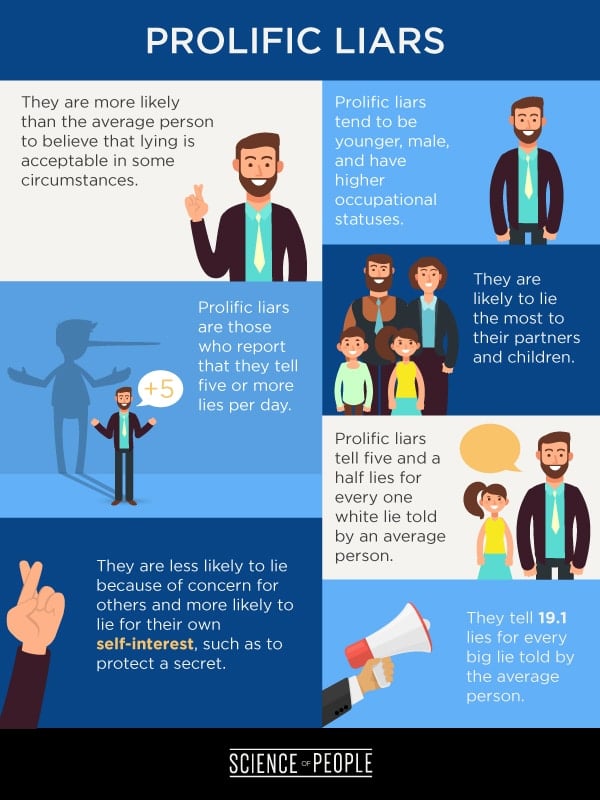
Luckily, we've got a way to place prolific liars. In the written report Variance in the Prevalence of Lying , researchers created a statistical model for distinguishing prolific liars from the everyday "normal" liar.
Here are some distinguishing characteristics of prolific liars:
Instance Report: Amanda Knox
Amanda Knox was accused of murdering her roommate, Meredith Kercher in Umbria, Italy in 2007. She denied doing it in her interview, just there were some central lying cues I found that suggest otherwise.
Watch her video interview along with my breakup:
Was Amanda Knox Really Lying?
↑ Table of Contents ↑
#two: Find The Nose
Now nosotros all know the old story of Pinocchio and how, whenever he lies, his nose gets really large.
And while it'southward a funny way to portray lying, in that location's likewise quite a bit of truth backside Pinocchio's olfactory organ.
You see, whenever nosotros lie, our olfactory organ gets a little itchy. I know… It sounds a bit weird. Especially when yous hear that our nose contains something called "erectile tissue" (yes, the same tissue that forms our sensitive parts!).
According to neurological managing director Alan Hirsch, when a person lies, "blood menstruum increases to the erectile tissues in the torso, including the erectile tissues in the nose." This is why liars frequently touch or scratch their nose.
So if you lot were wondering why Pinocchio's lying cue is his nose… it's no coincidence.
And exercise you know who a great example of nose touching is? Bill Clinton.
In Clinton's 1998 g jury testimony in the Monica Lewinsky instance, neurologists found that when the sometime president "was true, he never touched his nose." However, when Clinton lied… "he gave a split up-2d pout and touched his nose once every 4 minutes subsequently."
And hither'south the near surprising office—Bill Clinton ended up touching his nose a total of 26 times during the testimony. Was he lying? Most undeniably, refutably, 100%…
Yeah!
Here's a curt clip of Bill Clinton, where yous can run across him rubbing / scratching his nose equally a lying cue.
Special Note: This doesn't mean all people who bear on their noses are liars—sometimes a person might have a runny nose, or it might just be cold exterior. Context is important, and nose touching is merely i statistical cue to notice deception.
And then how practice we know for sure when someone is lying?
Apart from certain lying cues like nose touching, people often give away certain microexpression "tells" when they are lying, which are hard to fake.
↑ Table of Contents ↑
#3: Touching the Neck
When people tell lies, it doesn't merely come out verbally. A lie oftentimes makes a quick stop in the cervix on the way upwards, making the cervix a great hotspot for detection deception.
If a person touches their neck, it can be an indicator of increased sweat due to nervousness or anxiety from being caught in the act. If a person is wearing a collar, they might tug at it or conform it instead to seem less obvious.
The Peases cite researcher Desmond Morris as the first person to discover that lying causes a tingling sensation in the facial and neck tissues. People unremarkably scratch their neck to go rid of this tingling.
The Peases also conducted their ain observations. Here's what they constitute:
When people lie, they scratch their necks an average of 5 times each fourth dimension they scratch— rarely more, and rarely less.
↑ Tabular array of Contents ↑
#4: Spotter for Mismatched Hand Gestures
People who are sincere and honest will brandish gestures that match, specially with their easily. For example, if y'all tell someone their jiff is stinky, they might cross their arms, pocketbook their lips, and clench their hands into tight fists.
On the other mitt, liars may show body language that indicates 1 thing, merely their hands might not match up.
For example, let's take a look again at Bill Clinton. In an interview about the Monica Lewinski scandal, he clearly says "I did not have sexual relations with that adult female":
Merely here's the dead giveaway that shows he'due south lying: his hand gestures don't lucifer up with where he's looking!
Clinton clearly looks to his left, merely he is pointing in front of him. When wrongly accused, people will look directly at their accuser and, if pointing, will point in the aforementioned management. Not a different one.
Clinton probable pointed abroad because he didn't feel plenty conviction in what he was saying to confidently indicate to where he was looking.
This type of disconnect in gesturing is a surefire way to spot a lie.
↑ Table of Contents ↑
#5: Pay Attention to The Ears
You might be familiar with ear pulling from the famous actress, Carol Burnett.
But ears aren't simply for listening. Many people might not know they are a peachy indicator of lying, too. Specifically, pulling or touching the ears is a subconscious way to end hearing the lies a person is telling. In more than obvious cases, if a person who rarely lies feels embarrassed or actually nervous, their ears might affluent a bit red and rise in temperature due to increased blood menstruum.
The Peases mention these other variations of ear touching: rubbing the back of the ear, tugging the earlobe, putting the fingertip within the earlobe, and bending the entire ear to cover the earhole.
↑ Table of Contents ↑
#6: Look for The Microexpression Tell
When people tell lies, they are usually sad, angry, or fearful. They want to hide from the truth.
"Human beings are not creatures of logic; we are creatures of emotion. And we practise not care what's true. Nosotros intendance how it feels."
— Will Smith
And so the problem goes…
- Nosotros don't want to tell the truth.
- We tell a lie instead.
- We experience bad about lying.
Somewhere in that equation, we tend to give away piddling facial cues to signal that we're lying. And most well-seasoned liars know this. They know that when we prevarication, we tend to give off multiple little negative signals that expose ourselves.
That's why they learned to suppress their emotions. Liars might even await unnatural in the act, like their face is displaying an unnatural, blank-stare look.
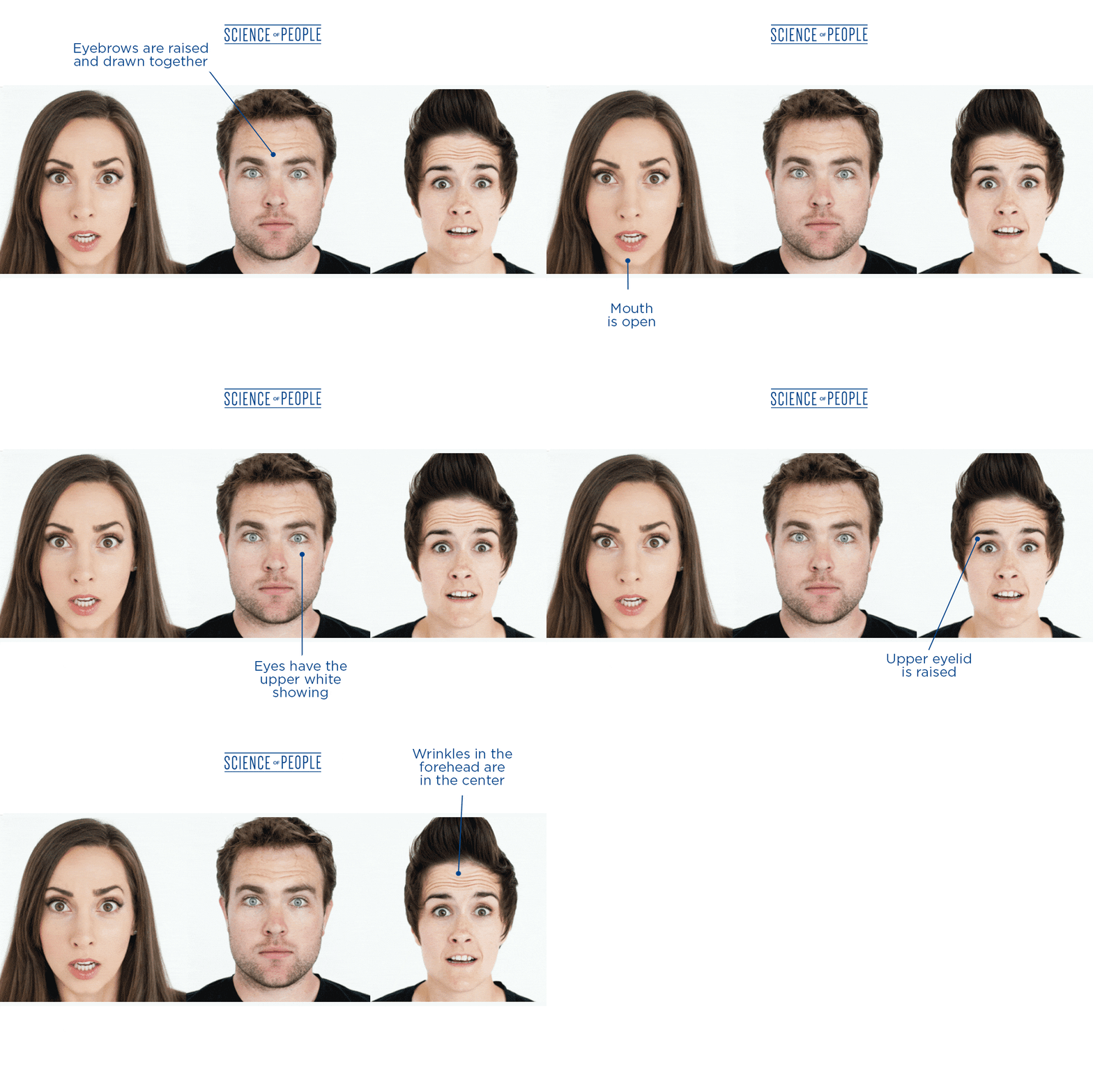
For example, here is the fearfulness microexpression—which liars may employ when they are agape they will be caught—down below.
Fear Microexpression:
Y'all can observe out more near microexpressions in our commodity:
The Definitive Guide to Reading Microexpressions.
Most of the time it won't expect so obvious, only at that place will usually be a small tell to give them abroad. For example, let's say y'all ask your dominate about a possible pay increase and he says in a cheerful tone that it's definitely possible in the future. Simply right subsequently request, you discover his mouth slightly opens, lips go tense, and his eyebrows are raised and drawn together in a straight line. You lot might approximate correctly that he's actually agape of giving you a raise and doesn't experience comfortable bringing it up once more.
And these tells tin can happen fast. The Peases conducted inquiry using slow-motion cameras and concluded that these signals tin can occur inside a split 2nd, and only professional interviewers, salespeople, and other very perceptive people can read them.
Unless you know the right approach, which nosotros'll cover in the adjacent pace…
↑ Tabular array of Contents ↑
#seven: Become a Human Lie Detector
Now that we've talked most prolific liars, nose touching, microexpressions, and personal pronouns… It's finally time to accept things one step further. If you really desire to be a prevarication-detecting wizard, at that place's just One way to greatly and reliably meliorate your lie detection abilities.
In fact, afterwards many years of teaching lie detection skills to real students, real employees, and real people…
I've come up to the conclusion that:
The all-time way to meliorate prevarication detection is to use a science-based, systematic approach.
And I'm non talking about a lame test, where I give you an A for try.
No—I've found that the best fashion to learn is with 3 F's. That is, learning from:
- Factual and science-based information,
- From real-life examples, and most importantly…
- Fun! It certainly makes reality shows more interesting.
That way, you can discover the existent hidden emotions that people truly have deep downwards inside.
That way, yous can walk in a room and know EXACTLY who is lying and why. Aye, it'due south kind of like having a superpower.
THAT is why I created How to Be a Human being Lie Detector
I truly believe that detecting lies is i of the most important skills to learn in your life… And then if y'all're fix to join me, check out my form:
↑ Table of Contents ↑
The three Types of Lies
One day, while enjoying a prissy dinner with my friend John, out popped a question: "Vanessa, how did you experience about Samantha?"
Samantha was my ex-friend and ex-neighbor. She had smelly jiff, e'er let her dog poop on our lawn, and even had loud karaoke parties until 2 in the morning time! So naturally, I said:
"Samantha? She's great!"
But the thing is… I didn't like her. I told a lie, and non only was I lying to John… but I was besides lying to myself.
This type of lie is called a lie of commission. And there are many types of lies—not just the obvious ones.
Do yous recall that little oath. "I swear to tell the truth, the whole truth and nothing but the truth"?
Other than being used in the courtroom, it's a great manner to identify the types of lies.
How? Permit'south swoop into it!
↑ Table of Contents ↑
"I swear to tell the truth" – Lies of Commission
If someone tells you something that is not a fact… we call this a prevarication of commission. This can be anything from lying virtually how you feel, to lying about your social condition, to lying in a human relationship.
Basically, when someone tells a prevarication of commission, they accept the truth and twist information technology to create a (unremarkably more favorable) version of something that happened.
Like when I told John that Samantha was keen. Or when people become virtually our mean solar day, telling others they feel "adept" when all they really want to do is go home and caress with the blankets.
How to tackle these lies:
If people go about their lives just telling others that they're great, or this person is fantastic, or the world is all fine and dandy when it's not… how do we tell the lies from the truth?
That'south when it striking me.
For these lies to succeed, you lot have to be willing to believe the prevarication. Not just hear it, but really, truly, believe in it.
In other words, yous take to finish living in autopilot way. Stop accepting that everything is true. Cease believing the words, and start listening to the deeper meaning of what people say.
Go skeptical, and enquire questions. This will make yous retrieve before yous nod and agree, "Yes" to everything that people say.
Here's some other trick— when someone says something you lot suspect is a lie… showtime, wait.
A day, or a calendar week later… Come up back to them and inquire them to repeat it. If he or she suddenly tells yous a different story, then this probably ways that there is something else going on. Time to investigate!
Next up is our second type of lie…
↑ Table of Contents ↑
"The whole truth" – Lies of Omission
Dissimilar the first lie where information technology's but manifestly wrong info… Lies of omission are lies because there is something missing.
When a lie of omission is told, important details are left. Does this make lies of omission whatsoever better than lies of commission?
Nope…
In fact, they can be even nastier because they're harder to spot and take less effort than making up a whole new lie. And it'due south not just giving a shrug when you go habitation and your spouse is asking nigh the dirty socks left in the kitchen.
Recollect of it like this—suppose you are buying a used car, and you spot a 2019 Honda Accordance. Yous ask the car salesman about more details.
"Oh, don't worry about that! This motorcar is great! Only 1,000 miles, one owner, pet-free, full tank, it's a steal!"
He fails to tell yous, however, that the engine was just submerged in common salt water. Or that all the tires were blown out and replaced. Or that the machine needed a new paint job.
That's 100% a lie of omission that he told you lot, and a lie you could have avoided.
How to tackle these lies:
Detecting these lies can be a bit tricky, so you'll have to practise some digging. And brand no mistake about information technology: if yous don't ask all the questions, you might not uncover all the truth.
It's just like the saying: "Ask the right questions, and the answers will ever reveal themselves."
Except in this case, it might be more advisable to say:
"Inquire ALL the questions, and the answers will always reveal themselves."
It's not but about asking the right questions, but being thorough in your questions equally well.
In the salesman scenario, if you had any doubts virtually the condition of the car… y'all could merely ask the salesman to show yous the maintenance log of the car. That way, in that location's no adventure of lying.
But once again, the key here is being thorough. Being ignorant is non plenty, because you might just let that automobile salesman put a happy smile on your face and take your money. You take to know when someone is omitting critical information from you, and that usually comes from feel or do.
↑ Tabular array of Contents ↑
"And nothing but the truth"
The last part of the adjuration is important. This is when sometimes people will tell you information completely unrelated to the truth in order to cover upwardly a lie.
This is what we call in the lie detection business, a character lie or a lie of influence. These lies are meant to make you believe the liar… or at the very least, pump them up to brand them sound like a not bad, magnificent human being incapable of telling lies.
Let's look at an case. You work at the local Walmart and a colleague has been taking money from the greenbacks registers. Information technology's your chore to notice out who information technology is. Y'all interview Mary and inquire her if she took the money. Her response is, "I've worked here for 15 years!" This is a typical grapheme prevarication. By telling you lot how long she'south worked at Walmart, Mary is trying to make it seem highly unlikely that she took the money.
Note how she only told you how long she's worked at Walmart! She has not told you that she didn't take the money. Be very wary for these types of lies. Whenever someone is trying to convince y'all of how great they are similar in the example to a higher place, they are probably attempting to cover something up.
How to tackle these types of lies:
Communicable these lies is actually pretty piece of cake. All you take to exercise is really listen to what someone is telling y'all. Are they giving you lot an reply to your question or are they just making a statement about themselves? If it's the latter, then you need to enquire the question over again to go to the truth.
Now OBVIOUSLY there are some good actors out there (like the murderers mentioned above), and so detecting lies if you've never done it before can be HARD. So bear the following in mind…
I've studied and been formally trained in prevarication detection for YEARS… and however, my success charge per unit is not 100%.
Nevertheless, my lie detection is practiced enough that I tin confidently say I am at the level of a Truth Wizard (mentioned above).
Over the years, I've formulated a Laser precise method of practicing lie detection (and there's plenty of practise fabric in the course). "Practice" might non sound then glamorous, but let me make this absolutely articulate…
Practicing prevarication detection is ESSENTIAL to becoming good at it.
In the form, I outline the best methods to practice spotting lies—even in real life.
Now it's your plow…
↑ Table of Contents ↑
Practise!
At present that you lot know how to distinguish the different types of lies, allow'due south encounter if you can manage to tell which type of lie is used in the following sentences.
A – I would never do something like that!
B – Q: Exercise I expect fat in this dress? A: No, honey.
C – Q: Where were you yesterday? A: I went to the role (neglecting to tell you lot he also visited his mistress)
D – Q: Is this a expert neighborhood to live in? A: Yes, nosotros're good friends with the people adjacent door (not telling you the people across the street are actually very nasty people).
E – Q: Are you having an affair? A: I've been happily married for 20 years!
F – Q: How much money are you making? A: About $three,000 a calendar month (While really making $two,200)
Answers
B and F: Lies of commission. Of course B is kind of a play a trick on question because y'all would never tell your partner she looked fat in that dress. Correct? Either style, both are straightforward lies that tell you lot something other than the truth.
A and E: Lies of influence. These people are trying to make themselves look better to avoid suspicion. Proverb, "I would never do something like that" isn't the aforementioned as "no", which is the answer someone telling the truth would give you.
C and D: Lies of omission. Here, an of import function of the truth is left out to avert having to tell a lie of committee. That, of grade, doesn't brand information technology right!
How well did you exercise? Did y'all get your 3 types of lies correct? Getting this stuff down 100% volition literally TRANSFORM your ways of thinking and assertive what people say. Information technology'll as well assistance you get someone to confess if that'southward what you want.
But even if y'all're only at fifty%, you're already further than everyone else if you've read this far.
↑ Tabular array of Contents ↑
How to Train Your Lie Detection Skills
While detecting deception is never like shooting fish in a barrel, quality training can meliorate a person's ability to find lies.
The fact is, many people—without any prior training—think they can observe lies…
Still, what they think doesn't matter.
The proof is in the numbers. Almost people are terrible at detecting lies because they all the same believe in old lying myths. Because they scout what they see on telly, and think catching lies is easy.
But here's the interesting office…
Spotting lies tin can be piece of cake—much easier than y'all call up.
In my grade, I teach my secret lie-detecting noesis that helped thousands of people go lie-detecting masters and accept command of their own life…
So are y'all set to have on this course and develop a earth-class skill? Yous've already made it this far… You volition not be disappointed.
So hither are the keys—now information technology'southward your turn to start the engine.
Sign upwards for the course: How to Be a Human Prevarication Detector
Source: https://www.scienceofpeople.com/how-to-tell-if-someone-is-lying/
Belum ada Komentar untuk "When You Know Its a Lie"
Posting Komentar