When Will Hale-bopp Comet Pass the Earth Again

Hale-Bopp and Hyakutake
Comet Hale-Bopp
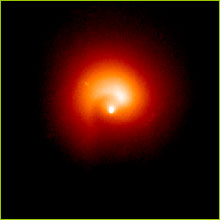 The epitome of Comet Hale-Bopp blazing across the night sky of 1997 has delighted casual stargazers and astronomers alike. It was start spotted in July 1995 by Alan Hale and Thomas Bopp, who observed information technology the aforementioned night in neighboring states (New Mexico and Arizona, respectively). Astronomers immediately became excited nearly the comet because information technology appeared to exist unusually bright—even when information technology was notwithstanding well outside Jupiter's orbit. Careful analysis of a Hubble Space Telescope image indicated that reason for Hale-Bopp's brightness was its exceptionally large size. The nuclei of near comets are about one-2 miles across. The nucleus of Halley's comet, which is considered to exist fairly big, was approximately ten miles across in its largest dimension. Hale-Bopp's nucleus is estimated to be 25 miles across.
 Even though Unhurt-Bopp is farther from the World than the Globe is from the sun, it has ready an all time visibility record—remaining discernible to the naked eye longer than whatever other comet in recorded history. First glimpsed in Australia in May 1996, Hale-Bopp should remain visible until the stop of 1997. This 18-month spectacle volition last twice as long as the previous record holder, Comet Flaugergues, which was visible to the naked center for nine months in 1811.
Hale-Bopp also may have fix a record for the amount of fourth dimension information technology has remained at high brightness or "magnitude 0," but astronomers caution that brightness is a difficult feature to measure and that historical records are not ever reliable in this regard.
Mayhap the most heady feature of Hale-Bopp is its unique tail. Like most comets, it has 2 tails that can be seen by the naked eye under the right conditions: a bright grit tail, which is created by the reflection of sunlight on the dust streaming from the comet, and a fainter ion tail, which is composed of electrically charged atoms swept from the comet by the solar wind. Just in April 1997, a grouping of European astronomers using one of the world'due south most powerful telescopes at La Palma in the Canary Islands, found a third tail. Setting spectroscopic instruments to exclude all light from the comet except the yellow light emitted by sodium atoms, the scientists were surprised to see a narrow third tail located near the ion tail. They approximate that this new sodium tail, which is not visible to the naked eye, is about 373,000 miles broad and about 31 million miles long.
Throughout history and across cultures, people have viewed the passing of a comet equally an omen: a sign of something skillful, or bad, to come. The ancient Greeks believed that comets foretold war, or an outbreak of disease. The ancient Chinese believed that a comet sighting might exist followed by affliction and political upheaval, but they also believed that a comet might indicate a adept harvest. The number of tails the comet had was of import; a 3-tailed comet was a bad sign, simply a ii-tailed comet was adept one. What the new revelation about Hale-Bopp'southward tail would mean to the ancients is anybody's approximate, but information technology undoubtedly provides an heady new surface area of report for astronomers.
Comet Hyakutake
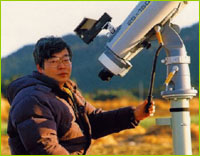 In the leap of 1996, stargazers were treated to a smaller, but closer, comet. Discovered on January thirty, 1996 by an amateur astronomer from southern Nippon, Comet Hyakutake (pronounced "hyah-koo-tah-kay,") came thirteen times closer to the Earth than Hale-Bopp.
In that location were two unusual aspects to comet Hyakutake's orbit around the Sun. First, the aeroplane containing its movement was nearly perpendicular to the aeroplane that contains the Earth and other planets. This meant that the comet probably originated from the Oort Deject rather than from the Kuiper Belt (see Comets 101). Secondly, and more than importantly, Hyakutake passed VERY close to the Globe on March 25, 1996. Although Hyakutake's miss distance was simply the fifth closest of this century (comet IRAS-Araki-Alcock came iii times closer in 1983), the other comets that came closer were all considerably less active, and therefore less bright, than Hyakutake. In fact, not since 1556 has a comet as agile as Hyakutake passed as close to the Earth as Hyakutake.
Careful studies of Hyakutake's orbit indicate that it terminal passed this close to the Sunday almost 8,000 years ago and will make its adjacent passage well-nigh 14,000 years from now. Unlike the instance of comet Halley, in that location'south no chance that any of us will ever run across Hyakutake once more.
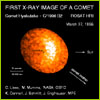 In the leap of this year, shortly after comet Hyakutake was discovered, the scientific community swung into action. Hyakutake was the nearly intensively studied comet since Halley, and astronomical observatories all over the earth
  focused their sights on this at present famous celestial visitor. The upshot was a bonanza of exciting new discoveries. Amidst the near surprising was the discovery of 10-rays coming from the comet.
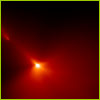
The Hubble Space Telescope produced the most detailed images of the comet, revealing a very dissimilar film than what could be seen with binoculars or wide-field telescopes. The Hubble images emphasized the ``center'' of the comet, the region well-nigh the nucleus, while wide-field pictures were dominated past light from the outer coma and tails.
 This candy Hubble image shows the bright jets of dust emanating from the nucleus more conspicuously.
A portion of the Hubble image shows three companions to comet Hyakutake. Scientists believe that the surface of Hyakutake'due south nucleus is 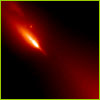 covered with a "crust," and that a piece of this crust was lifted off and diddled into the tail equally information technology disintegrated.
Several new molecules were discovered in comet Hyakutake that should provide important insights into the agreement of the origin of our solar organisation. Infrared observations revealed that Hyakutake's nucleus is loaded with hydrocarbon ices, like methane, acetylene, and ethane. Hydrocarbons are the basis of life, so scientists were excited to find then many of them in a comet. Electric current thermo-chemic models of the solar nebula (the gas and dust deject from which the solar system formed) advise that ethane and acetylene should be much less arable than marsh gas, merely this was not seen in Hyakutake. Scientists may demand to revise their understanding of the early solar arrangement or entertain the thought that comets consist primarily of interstellar fabric—the thing between the stars that somewhen collapses into the clumps that get new stars.
Kitchen | Venus | Resources | Table of Contents
Source: https://www.pbs.org/wgbh/nova/spacewatch/comets.html
Belum ada Komentar untuk "When Will Hale-bopp Comet Pass the Earth Again"
Posting Komentar